Still Alive: Patricia's Story
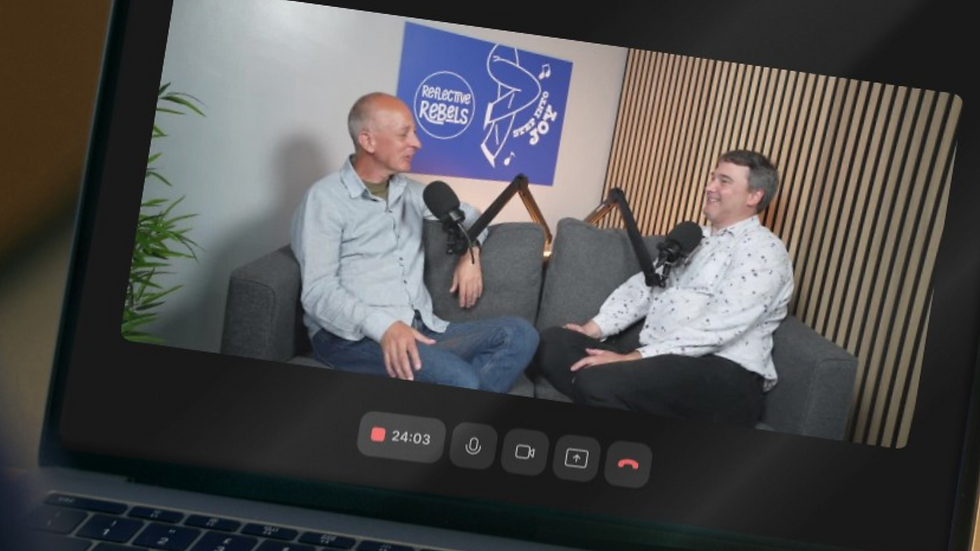
Reflective Rebels Podcast: Season 1, Episode 3
Patricia's story spans continents and life-changing moments - from building a life in Hong Kong to counselling prisoners, from running a business to facing death twice in a hospital bed. After a stroke forced her to rebuild everything, she discovered what truly matters. This is a conversation about jumping off cliffs, finding unexpected humanity in dark places, and what facing death teaches us about being alive.

"I still wake up every morning and think I'm still alive."
Patricia says this quietly, like someone sharing a secret. Not with drama or fanfare, but with the kind of gentle amazement that comes from having your entire understanding of existence shifted in a hospital bed.
This daily realisation - this moment of gratitude for simply being conscious - didn't exist before November 2021. Before the stroke that would force her to rebuild everything from how she read words to what actually mattered in life.
But Patricia's story isn't just about surviving a medical crisis. It's about a woman who spent decades jumping off metaphorical cliffs, finding unexpected humanity in the darkest places, and discovering that slowing down isn't a luxury - it's essential.
Adventures Without a Net
Patricia and her husband Paul have made a habit of leaping first and looking later. In the mid-80s, when Ireland's economy was "on its knees" and there was "no work," they took a job offer on the Isle of Man.
A few years later, a corporate restructuring deal led to a Dutch bank job offer, and they found themselves in Hong Kong with no safety net. "We just thought, well, go for it," Patricia remembers.
"We upped sticks, life was uncomplicated, we had no children, we upped sticks and off we went."
Hong Kong was sensory overload. Nine million people after 70,000 on the Isle of Man. A city that "never sleeps" with "noise 24-7" where "nobody around you speaks the language you understand." On her first day at an Australian accountancy firm, Patricia was handed 12 Cantonese-speaking staff members and had exactly two words of their language.
"You have to use an awful lot of instincts to survive," she explains. The pressure was unlike anything she'd experienced - working Saturday mornings was normal, and "if you didn't keep up, you would get left behind."
Yet they thrived in that hothouse environment, traveling extensively and building skills that would serve them for decades. When they eventually moved back - another cliff jump, this time with no jobs lined up because Patricia's mother was dying - they carried that confidence with them.
"We had confidence in our skills. We knew that we would get jobs," Patricia reflects. That confidence would be tested repeatedly, but it held.
Finding Humanity in Dark Places
Back in the UK, Patricia answered an ad for bereavement and trauma counsellors. She never expected to get selected, but found herself working in the Isle of Man's Victorian-era prison - "like the prison you see on the program Porridge."
The work brought her face-to-face with drug dealers, rapists, murderers, and people who were both perpetrators and victims. What she discovered challenged every assumption about darkness and humanity.
"I never laughed as much doing a job in all my life"
she says, describing the gallows humor that kept staff sane in that environment. She met a drug dealer who was also a "beautiful poet" and learned that seeking help takes "huge bravery, not failure."
The prison taught her that "backing off is not a failure and backing down is a route that you need to take." Sometimes the strongest thing you can do is know when to step back.
One particularly intense moment involved a drunk, aggressive boyfriend breaking into a counseling session. Patricia's response?
"I said, look, I'll just knock you out if you like, or you can just continue shouting."
The shock tactic worked - he started crying and apologized.
"Not very well thought out but bravery I'm not so sure," she laughs now. But it taught her about watching people carefully, listening deeply, and recognizing that "their bravery, not mine" was what mattered most.
The Business Years
Patricia and Paul eventually moved to Cumbria to start their own accountancy practice. "We moved with two children, four dogs and two horses and a cat," Patricia remembers. "We came with one client. A big client, but that was it."
Working side by side as partners proved challenging in ways they hadn't anticipated. "Everybody has a different persona outside of the workplace as they do in the workplace," Patricia explains. The pressure of making everything work while managing family life was intense.
After five years, Patricia stepped away to work elsewhere while remaining a business partner. She threw herself into that work with characteristic intensity, working "all hours God sent" and becoming "stressed to hell."
Looking back, she questions why she wanted to return to what was "actually not a very great place." But at the time, it felt necessary, important, crucial.
Until it all stopped.
When Life Stops You
November 21st, 2021. Patricia had been feeling unwell for weeks, misdiagnosed with COVID, unable to get proper medical attention in the post-pandemic chaos. When her doctor finally made a house call, she was rushed to hospital as code red - critically ill.
"I had no idea really what was happening to me. Your brain just goes on fire and it just goes into all kinds of different places"
she remembers. Blood transfusions, stroke diagnosis, two weeks to stabilise, then another near-death experience that was "really, really scary because you're sitting there and you know something is wrong."
The physical recovery was gruelling. She couldn't read because the stroke damaged her peripheral vision. Getting dressed took two hours, often resulting in clothes on backwards that she'd refuse to wear all day. "That tenaciousness, I think, really kind of brought me through."
But the deeper recovery involved grieving who she used to be.
"You come out wearing a different set of clothes to the ones you went in on, metaphorically speaking"
She explains. The constant fear - "I was afraid of closing my eyes in case I'd die when I was asleep" - gradually gave way to profound realisations.
What Actually Matters
The stroke revealed uncomfortable truths about Patricia's pre-illness priorities. The business impact she thought was crucial "actually didn't matter. And it was a stark reality of how much it didn't matter to other people. It mattered a lot to me."
But it also revealed something beautiful: the support network that had been "hidden in plain sight" all along. Her husband Paul, who "made sure I had the space to recover at the pace that I needed to recover at." Her daughter Izzy, who bought workbooks for stroke recovery and supported them both. The circle of friends who "really did row in" without being "in my face."
"The things that are right in front of you that you just bypass... are actually the most important things, but you just walk by them as if they're nothing"
Patricia realizes now.
Opera and Freedom
These days, Patricia finds her deepest joy in an unexpected place: the Lonsdale Cinema in Annan, watching opera screenings alone. Her father was an amateur opera singer, and she still has his old 78 vinyl records.
"There's a freedom in my heart when I hear the music and I hear the voice and that beautiful instrument that is the voice that just soars"
she describes. "I absolutely love it... even though most operas are horrendously tragic and you end up in tears by the end of it."
It's a perfect metaphor for Patricia's journey - finding beauty and freedom in experiences that contain both tragedy and transcendence.
Kindness as a Way Forward
Patricia's perspective on daily life has fundamentally shifted. When people get "really massively upset," she asks them: "Is anybody going to die? This is where we start the measuring from rather than going full-on panic stations."
Her focus has turned to something simpler but more profound:
"If you can extend a hand of kindness, it's incredible the amount of difference that sometimes can make. And people underestimate it or people don't think about it or people are too busy."
She's planning more travel - possibly to India to trace her great-grandmother's roots. But the biggest adventure now is daily appreciation: "I take every day as it is... I still wake up every morning and think I'm still alive."
Your Story Continues
Patricia's journey from Hong Kong adventures to stroke recovery reminds us that life's biggest transformations often happen when we least expect them. Sometimes we choose to jump off cliffs, and sometimes life pushes us off. Either way, what matters is how we land and what we choose to do next.
The question isn't whether you'll face challenges - it's whether you'll recognise the support that's already around you, have the courage to ask for help when you need it, and remember that extending kindness costs nothing but can change everything.
What would change if you started each day thinking "I'm still alive" instead of immediately jumping into your to-do list? What matters to you beyond your professional achievements? And who in your life deserves more of your attention and kindness?
Patricia's story isn't over yet. Neither is yours.
If this conversation has stirred something in you and you're ready to explore your own turning point, perhaps join an upcoming event or drop me a message about coaching.
Because life's too short to struggle alone, and sometimes the most rebellious thing you can do is ask for support.


Comments